


The best AI podcast summarizer depends on how you get the episode and what you need afterward. Audio Converter AI is our first choice for uploaded podcast files because it creates an editable transcript before generating AI notes and summaries. Recall is better for building a connected knowledge base, Snipd is stronger for mobile listening, and Snipcast is convenient when you want to paste a link from a major podcast app.
This guide compares nine free and paid podcast summarizers by input method, transcript access, summary workflow, platform support, free limits and price. It is for listeners who want to skim long episodes, students and researchers who need searchable notes, and podcasters who want show notes or reusable content.
Best AI Podcast Summarizers at a Glance
Prices and allowances below were checked on November 16, 2026. Vendors can change plans, regional pricing and usage limits, so confirm the current checkout page before subscribing.
| Rank | Tool | Best for | Free access | Listed starting paid price* | Main input |
| 1 | Audio Converter AI | Podcast files, long recordings and transcript-first summaries | Free plan | From $4.49/month billed annually | Audio, video, recording and supported links |
| 2 | Recall | Saving podcasts in a connected knowledge base | 10 AI summaries/month | $10/month billed annually | Podcast episodes, YouTube, web and documents |
| 3 | Snipd | Mobile listening, highlights and podcast chat | 2 AI episodes/week | $6.99/month | In-app podcasts, audio files and YouTube |
| 4 | Snipcast | Spotify and Apple Podcasts link summaries | 2 summaries/month | $7.99/month | Podcast links and file uploads |
| 5 | Podwise | Structured learning and note-app exports | Basic free access | $5.90/month billed annually | RSS, OPML, public episodes and uploads |
| 6 | Podsqueeze | Show notes, clips and podcast marketing assets | 30 minutes/month | $5.99/month billed annually | Audio, video and YouTube |
| 7 | Castmagic | High-volume creator content repurposing | Paid plans | $19/month billed annually | Long-form audio and video |
| 8 | NoteGPT | YouTube podcasts and mixed study content | Free plan | $9/month billed annually | YouTube and local audio/video |
| 9 | Gemini Notebook | Free, source-grounded research workflows | Standard access with a Google account | Optional Google AI upgrade | Uploaded sources, audio, web and YouTube |
Prices shown are public list prices or annual-billing equivalents observed on the review date, before tax, promotions or regional app-store differences.
1. Audio Converter AI: Best Overall for Podcast Files
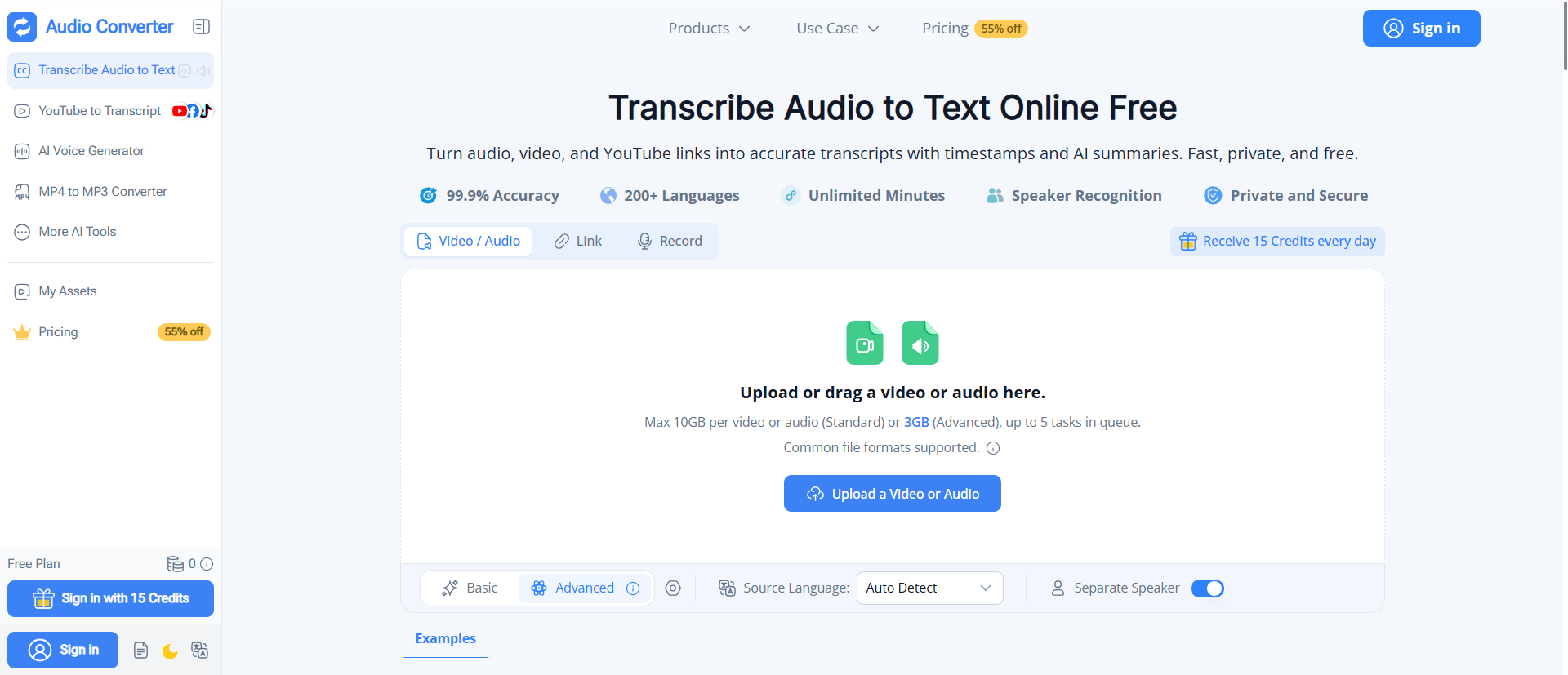
Audio Converter AI is our top AI podcast summarizer when the episode already exists as an audio or video file. Its advantage is the order of operations: it creates an editable transcript with timestamps and speaker recognition, then lets the user generate AI notes and summaries from that text. This transcript-first workflow makes important names, numbers and quotations easier to check than a standalone paragraph with no visible source.
Why we ranked Audio Converter AI first
Audio Converter AI combines several steps that are often split across different products:
- Work with common formats such as MP3, WAV, M4A, MP4, WebM and MOV.
- Transcribe content in more than 200 languages.
- Separate speakers in interviews and roundtable episodes.
- Review editable text with timestamps before relying on the summary.
- Generate AI Notes, summaries, mind maps and follow-up chat from the transcript.
- Start with daily free credits before choosing a paid plan.
The current Audio Converter AI pricing page lists a free plan with daily credits and up to 30 minutes of transcription, while paid plans increase monthly credits, file limits and processing capacity. Because allowances can vary by plan and interface, check the live pricing page before uploading a very long podcast.
2. Recall: Best for a Searchable Podcast Knowledge Base
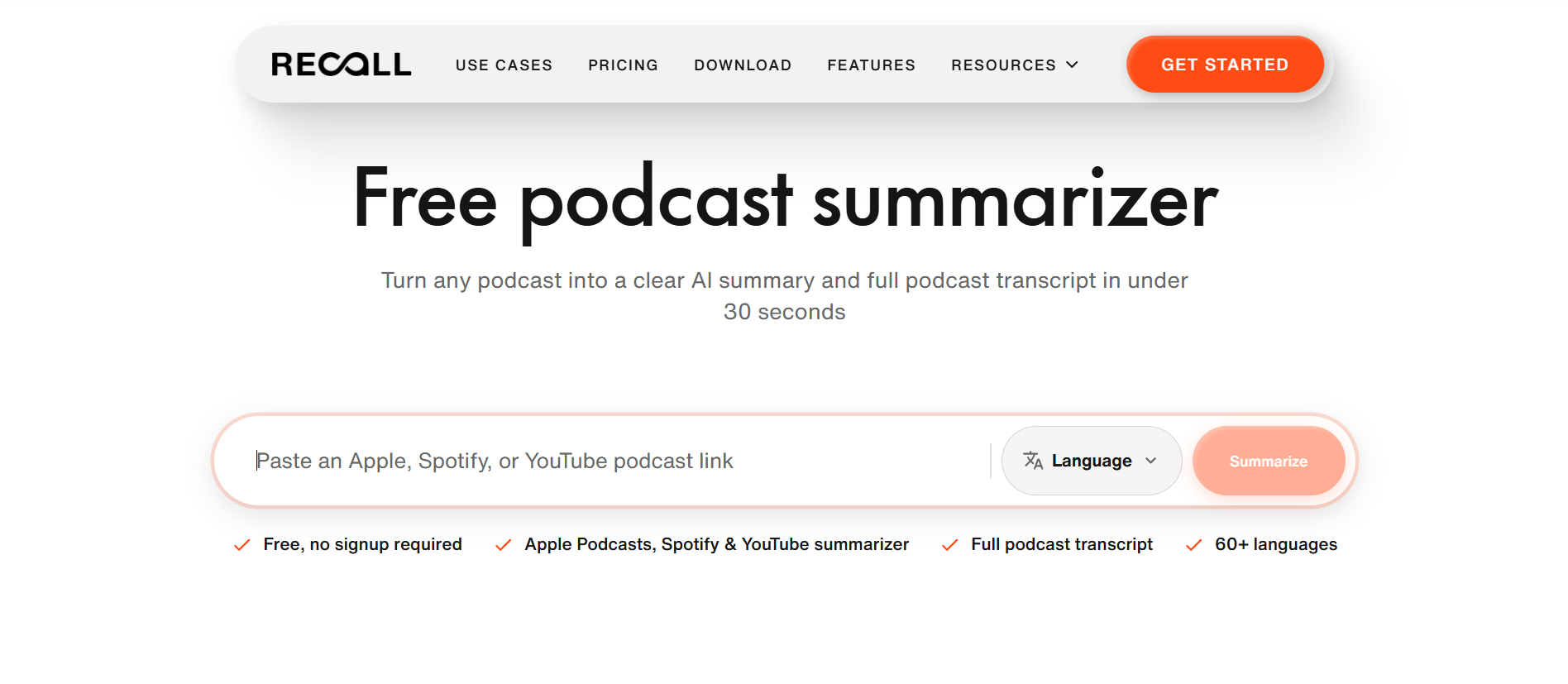
Recall is more than a one-off podcast summary AI tool. It saves podcasts alongside articles, YouTube videos, PDFs and notes, then organizes the material into a connected knowledge base that you can search and chat with.
Recall says its free plan includes unlimited saved content and 10 AI summaries per month. Its Plus plan was listed at $10 per month when billed yearly or $12 monthly as of October 2026. The product is a good fit for researchers and heavy podcast listeners who want insights from multiple episodes to remain connected instead of disappearing into separate summary pages.
Best for
- Building a long-term podcast research library
- Asking questions across saved episodes and documents
- Connecting podcasts with articles, PDFs and YouTube videos
- Listening to saved summaries with text-to-speech
Limitations
Recall adds a knowledge-management layer that occasional users may not need. If your only task is to upload one MP3 and get an editable transcript and summary, a focused file-first tool is more direct.
3. Snipd: Best Mobile AI Podcast Summarizer
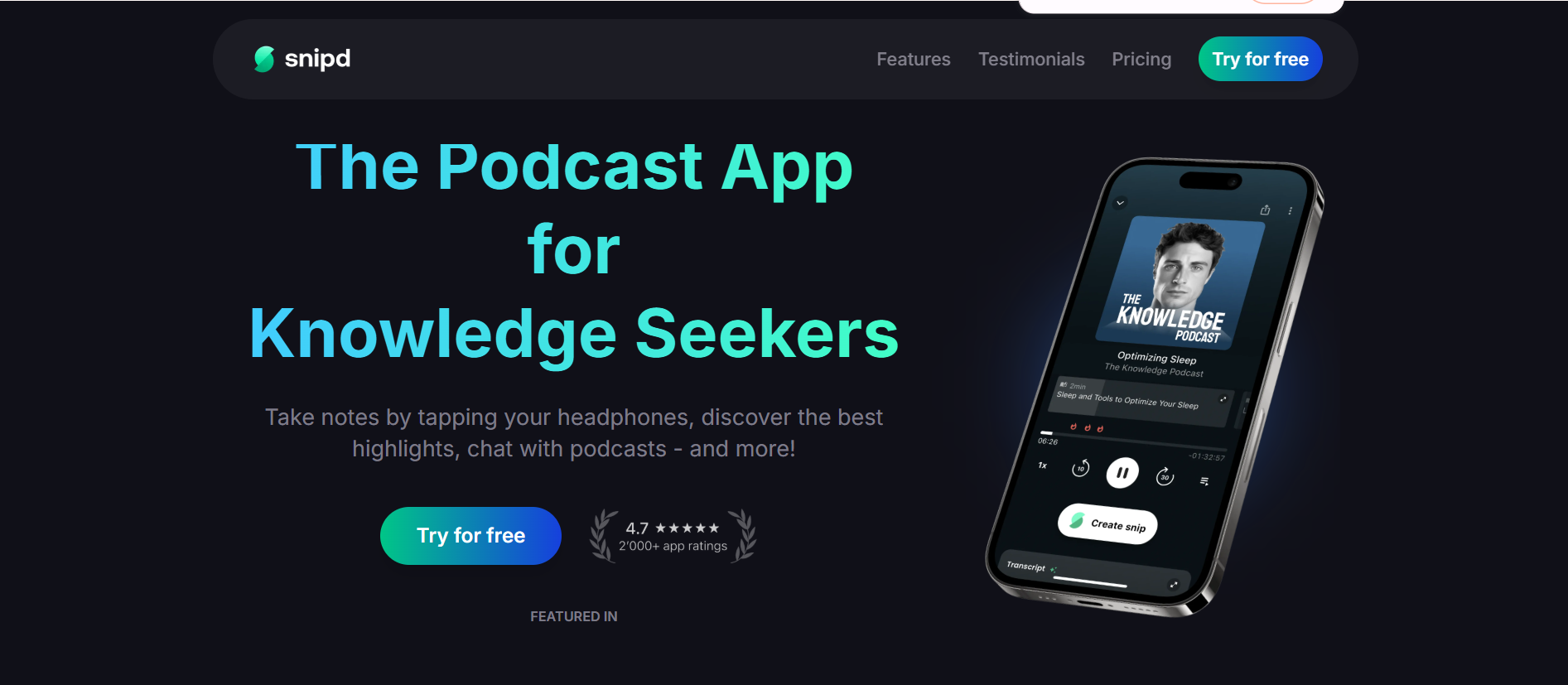
Snipd combines a podcast player with AI summaries, transcripts, chapters, highlights and episode chat. It is designed around listening: users can capture ideas while an episode plays, save highlights and sync them to services such as Notion, Readwise and Obsidian.
The free plan lists unlimited podcast listening with AI features for two episodes per week. Snipd Premium is listed at $6.99 per month, with regional app-store pricing possible, and includes broader AI access, episode chat, custom summary prompts, audio-file and YouTube imports, and up to 900 minutes of AI processing per month.
Best for
- Listening and summarizing in the same mobile app
- Saving podcast highlights while walking, driving or exercising
- Exporting notes to a personal knowledge-management system
- Chatting with an episode after listening
Limitations
Snipd is a complete listening environment, which is useful for podcast fans but less focused for creators who already have production files and only want a browser-based transcript and summary.
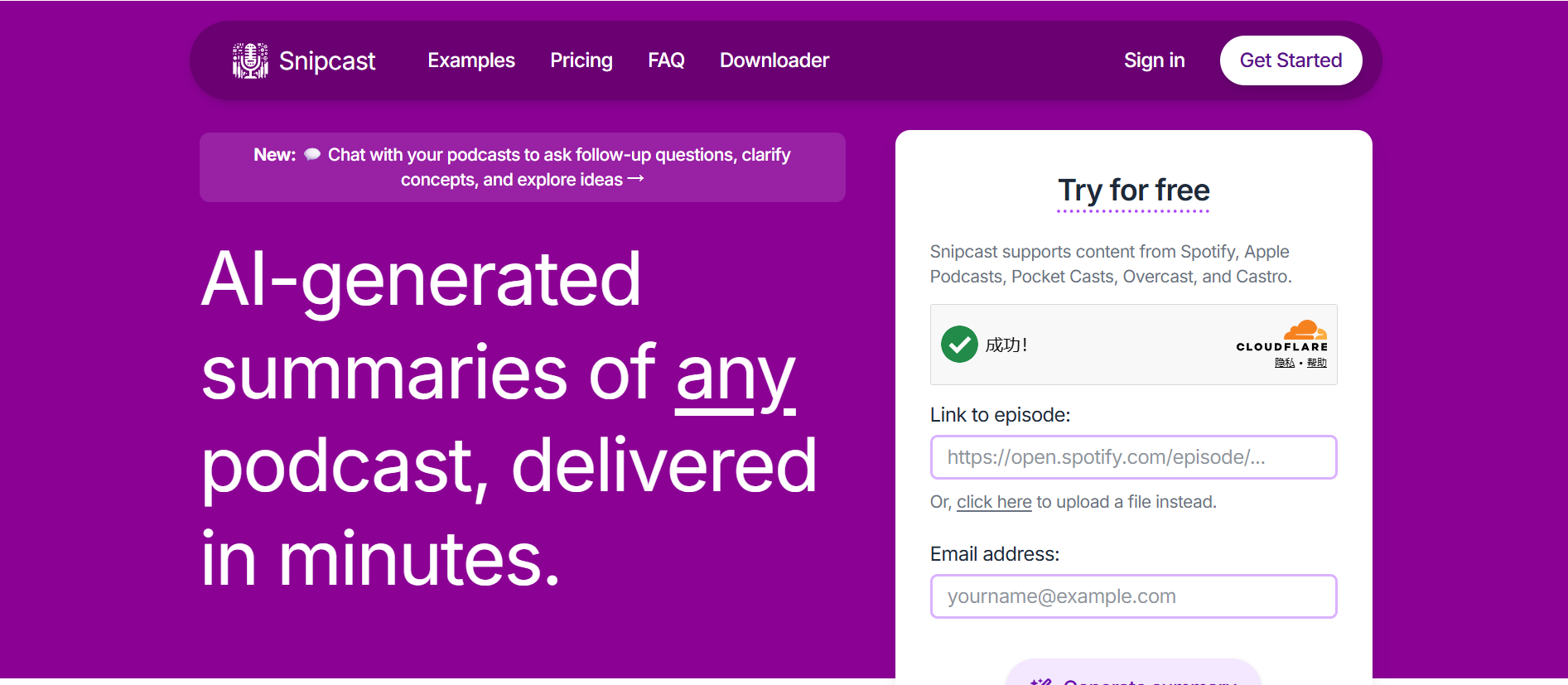
4. Snipcast: Best Spotify and Apple Podcasts Summarizer
Snipcast is one of the clearest choices for users specifically searching for a Spotify podcast summarizer or Apple Podcasts summarizer. Its public page says it accepts links from Spotify, Apple Podcasts, Pocket Casts, Overcast and Castro. Users can also upload an audio or video file and receive a summary by email.
The free plan lists two individual summaries per month, one podcast subscription and 10 chat messages. The Premium plan is listed at $7.99 per month with 50 summaries, 10 subscriptions, 100 chat messages, full transcript access and API access.
Best for
- Pasting links from major podcast players
- Receiving summaries without changing podcast apps
- Subscribing to recurring podcast summaries
- Email-first reading and follow-up chat
Limitations
Snipcast states that Spotify-exclusive podcasts are not supported when it cannot access the underlying audio. Full transcripts are also reserved for paid plans, so free users get less source visibility than with a transcript-first workflow.
5. Podwise: Best for Structured Learning and Exports
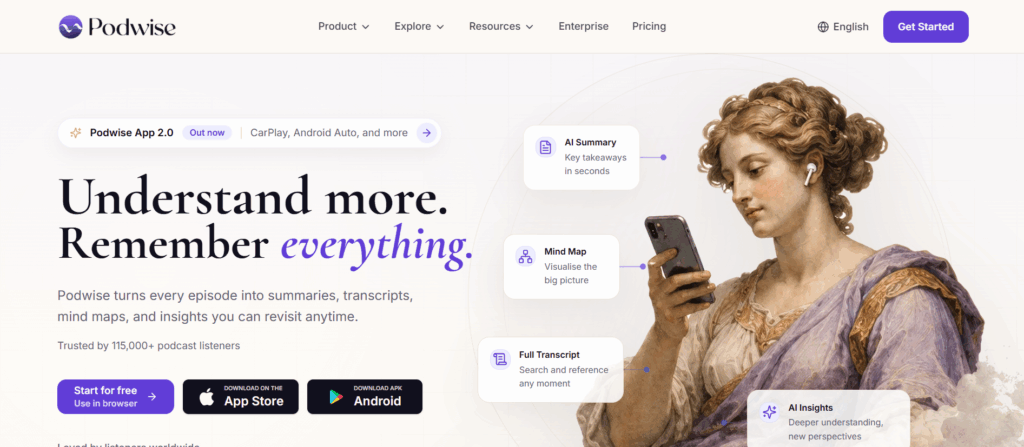
Podwise turns public podcast episodes and uploaded audio into transcripts, summaries, mind maps, clips, translations and question-answering experiences. Its strongest differentiator is the export workflow: users can send material to Notion, Readwise, Obsidian and Logseq or download XMind, Markdown and PDF files.
Podwise offers basic free access and a seven-day trial for paid subscriptions. Its Standard plan is listed at $5.90 per month when billed annually with 20 AI episodes per month; Pro is $11.90 per month when billed annually with 50 processing credits and broader API and AI access.
Best for
- Students and active learners
- Mind-map and structured-note workflows
- RSS and OPML imports
- Exporting podcast knowledge to a note-taking system
Limitations
The credit system deserves attention if you process many new or private episodes. Public episodes that Podwise has already processed may be easier to access, while new uploads consume processing credits based on duration.
6. Podsqueeze: Best for Podcast Show Notes and Promotion
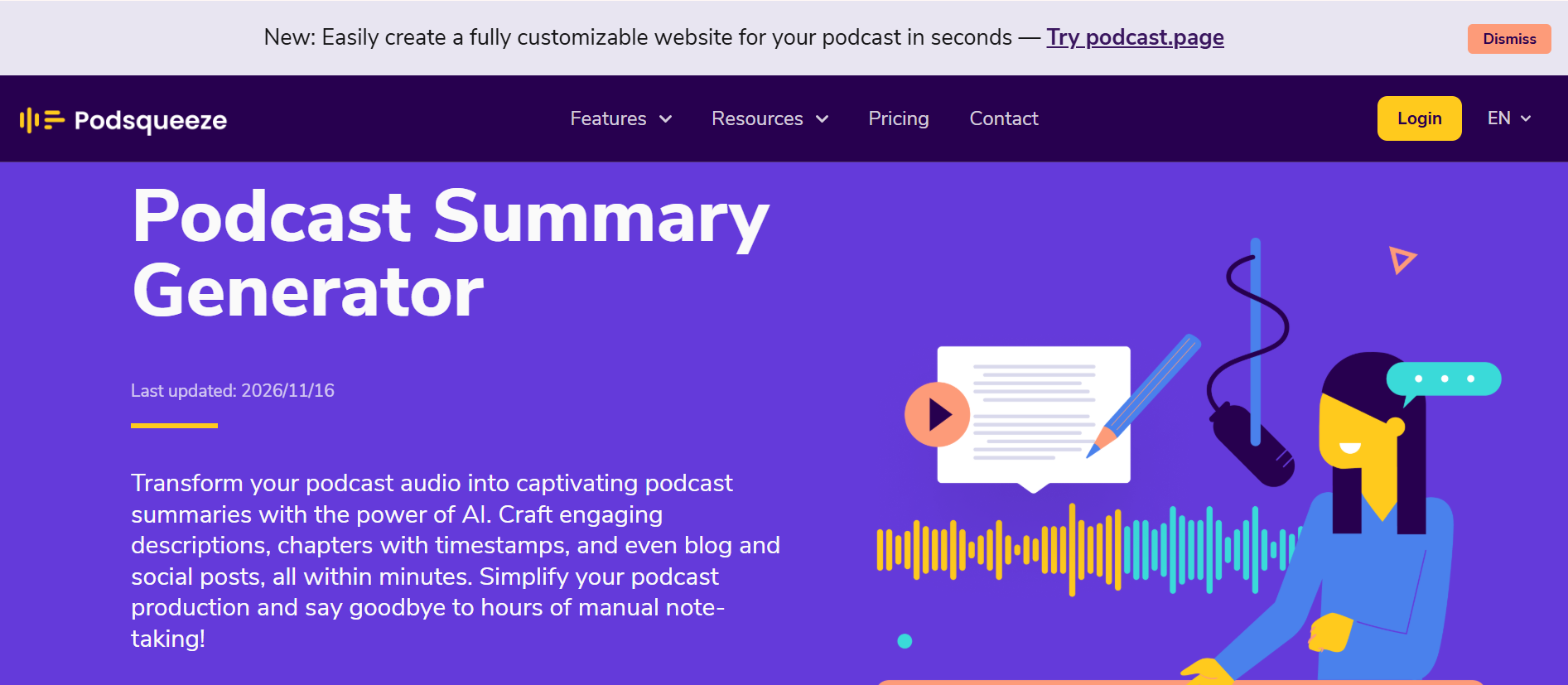
Podsqueeze is built for podcast creators rather than people who only want to read a quick summary. It can produce transcripts, show notes, titles, descriptions, chapters, clips, quote images, newsletters and social posts from an episode.
Its pricing page lists a free plan with 30 minutes per month. The Starter plan begins at $5.99 per month when billed annually and includes 120 minutes, while higher tiers add more minutes, larger files and creator or agency features.
Best for
- Podcast hosts creating show notes
- Turning one episode into multiple marketing assets
- Chapters, timestamps, clips and quote graphics
- Small podcast teams and agencies
Limitations
Podsqueeze may be more product than a listener needs. If you only want an AI summary of a podcast for personal learning, its promotional and production features can add unnecessary complexity.
7. Castmagic: Best for High-Volume Content Repurposing
Castmagic turns long-form audio and video into transcripts, summaries, show notes, blog drafts, newsletters, social posts and other ready-to-edit assets. It supports more than 60 languages and includes timestamps, playback, editing, collaboration and custom prompts.
The Hobby plan is listed at $19 per month when billed annually, with a library allowance of 30 transcribed hours. Starter and Team tiers expand storage, hours, seats and workflow features.
Best for
- Professional podcast creators
- Marketing teams producing many assets per episode
- Reusable prompts and standardized content workflows
- Collaboration across a long-form content library
Limitations
Castmagic is one of the more expensive options in this list. It makes the most sense when the summary is only the beginning of a larger content engine, not the final output.
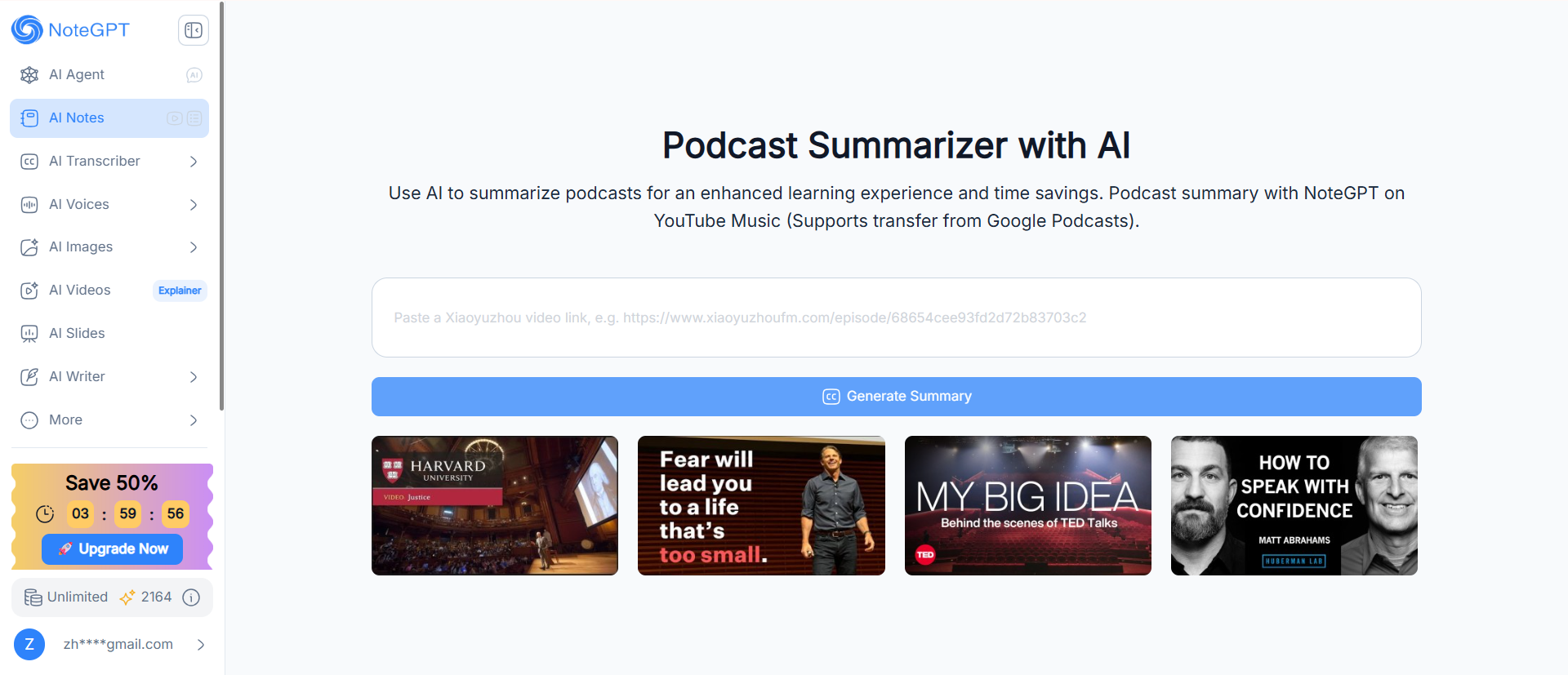
8. NoteGPT: Best YouTube Podcast Summarizer
NoteGPT's podcast summarizer focuses heavily on YouTube-based podcast and learning content. It can create a transcript, summary, keywords, key insights, mind maps, translations and AI chat outputs from supported videos and local files.
NoteGPT has a free plan. Its Pro plan is listed at $9 per month when billed annually or $9.99 monthly, with quotas for transcription, summaries and premium processing. Higher tiers increase local file size, YouTube duration, batch processing and AI credits.
Best for
- Video podcasts published on YouTube
- Students who also summarize lectures, documents and presentations
- Mind maps and mixed learning outputs
- Batch processing within higher plans
Limitations
The combination of basic and premium credits takes time to understand. Check whether your episode uses subtitles, premium transcription or local-file processing before comparing the headline price with simpler tools.
9. Gemini Notebook: Best Free DIY Research Option
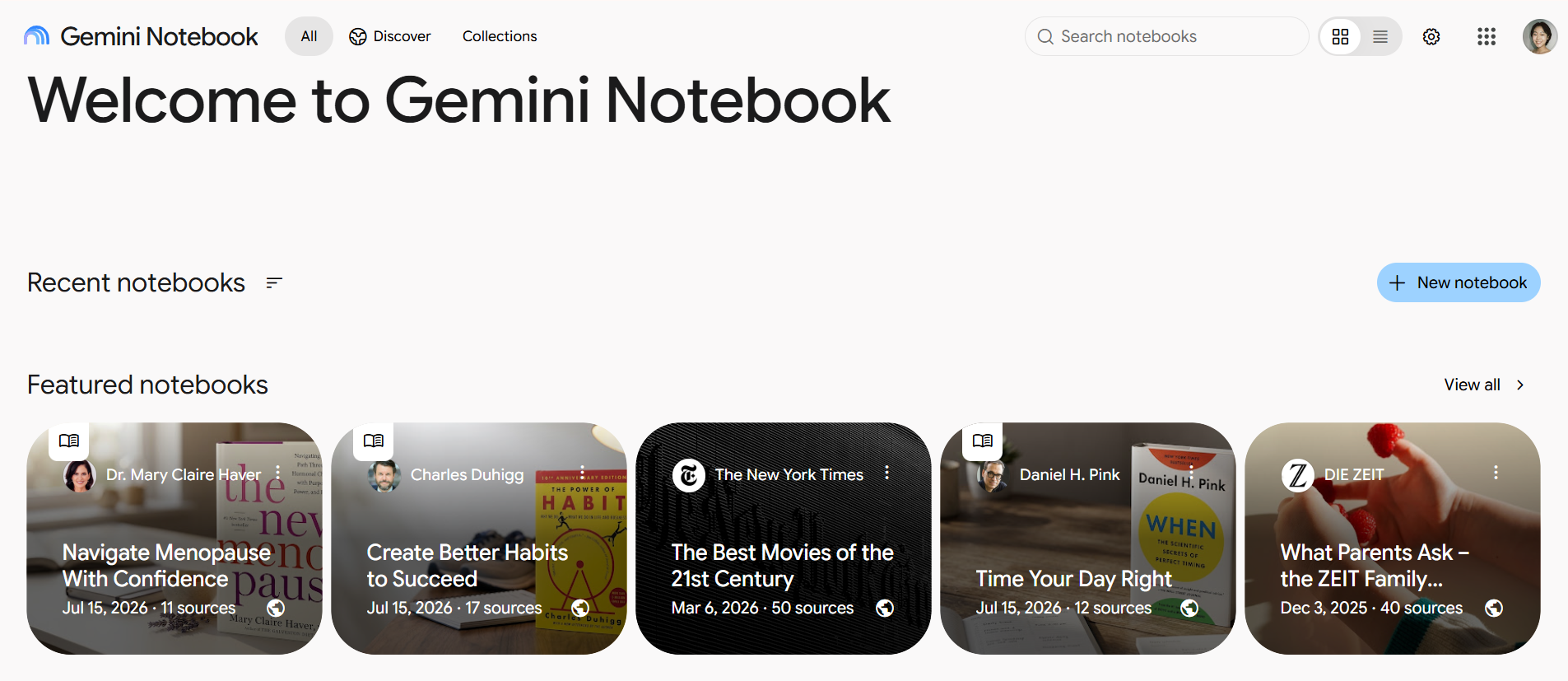
Gemini Notebook is a source-grounded research workspace rather than a dedicated podcast app. Users can add supported sources, ask questions and create reports or summaries. This is useful when a podcast transcript, audio source or public YouTube episode is part of a larger research project.
Standard access is available without a paid Google AI plan. Google's published limits list 100 notebooks, 50 sources per notebook, 50 chats per day and three Audio Overviews per day for the standard tier, although limits are subject to change. Paid Google AI plans increase those allowances.
Best for
- A free podcast summarizer workflow built around source material
- Comparing a podcast with documents, websites and research notes
- Asking grounded questions across several sources
- Generating study guides and alternative overview formats
Limitations
Gemini Notebook is not a conventional Spotify or Apple Podcasts summarizer. Users may need the transcript, audio file or a supported YouTube source first. Its Audio Overview feature creates a podcast-style discussion of sources, which is different from summarizing an existing podcast into text.
Best Free AI Podcast Summarizer
The best free AI podcast summarizer depends on the type of access you need:
- Audio Converter AI: best free starting point for a saved podcast file, transcript, speaker labels and AI notes. The free plan lists daily credits and up to 30 minutes of transcription.
- Snipd: best free option for mobile listeners; AI features are available for two episodes per week.
- Recall: best free research library; includes 10 AI summaries per month.
- Podsqueeze: best free creator trial; includes 30 processing minutes per month.
- Gemini Notebook: best free DIY research environment when you already have usable source material.
Free plans are useful for occasional episodes, but they usually limit minutes, new episodes, summaries, transcript access or AI chat. Compare the actual constraint with your average podcast length. A free allowance of two episodes may be better than 30 minutes if your shows are short; the opposite is true for a two-hour interview.
Best Podcast Summarizer by Platform
Best Spotify podcast summarizer
Choose Snipcast when you want to paste a supported Spotify episode link and receive a summary by email. Choose Snipd when you want Spotify-style discovery, listening, highlights and summaries inside one AI podcast app. Spotify-exclusive episodes can be harder for third-party services to process when the underlying audio is inaccessible.
Best Apple Podcasts summarizer
Snipcast accepts supported Apple Podcasts links, while Snipd provides an alternative listening app with summaries and highlights. Recall is a better option when the episode needs to become part of a broader knowledge base. Always test the exact public episode because feed and regional access can differ.
Best YouTube podcast summarizer
Audio Converter AI is the strongest choice when you want a transcript-first workflow with AI notes from a supported YouTube source. NoteGPT is a good alternative for users who want mind maps and other study outputs, while Recall works well when a YouTube podcast belongs in a larger research collection.
Best podcast summarizer for uploaded MP3, WAV or M4A files
Audio Converter AI ranks first for local podcast files because the transcript, speaker separation, timestamps and AI summary remain in one browser workflow. Snipcast, Podwise, Snipd, Podsqueeze and NoteGPT also accept uploads under plan-specific file or processing limits.
Transcript-First vs. Direct Podcast Summaries
Key definition: A transcript-first podcast summarizer converts the episode into searchable text before creating a summary. This makes names, quotes, numbers, timestamps and speaker statements easier to verify than a direct summary that provides no visible source text.
A direct summary may be enough when you only want to decide whether an episode is worth listening to. A transcript-first result is safer when you intend to publish show notes, quote a guest, use the material in research or turn it into another piece of content.
Choose a transcript-first tool when:
- The podcast has multiple speakers.
- Exact wording or quotations matter.
- You need timestamps, captions or a searchable archive.
- You plan to create show notes, articles or social posts.
- You want to ask follow-up questions and verify the answers.
No AI summary preserves every nuance. Check disputed claims, proper names, statistics and passages affected by background noise or overlapping speech against the original episode.
Can ChatGPT Summarize a Podcast?
Yes, ChatGPT can summarize a podcast when it can access the underlying content. According to OpenAI's file and audio upload documentation, supported ChatGPT experiences can transcribe and discuss uploaded audio, subject to plan, model, duration and regional availability. You can also provide a checked transcript and request a structured summary.
ChatGPT is not a universal podcast-link downloader. Pasting a Spotify or Apple Podcasts URL does not guarantee that ChatGPT can access and process the full episode. For long recordings, a practical workflow is to create the transcript in Audio Converter AI, review it, and then use AI Chat or another language model for a custom summary, study guide or content outline.
Podcast summary prompt
Use this prompt after you have a transcript:
Summarize this podcast transcript for a reader who has not heard the episode. Return: 1. A 75-word overview 2. Five key takeaways 3. The main argument and any counterarguments 4. Important names, numbers and claims that need verification 5. Notable quotes with timestamps only when the transcript provides them 6. Three follow-up questions Do not invent facts, quotations or timestamps. Mark unclear passages as uncertain.
Frequently Asked Questions
Is there an AI that can summarize a podcast?
Yes. Tools such as Audio Converter AI, Recall, Snipd, Snipcast, Podwise, Podsqueeze, Castmagic and NoteGPT can summarize podcast content. The right choice depends on whether you have an audio file, a YouTube video, an RSS episode or a Spotify or Apple Podcasts link, and whether you also need a transcript.
Which AI gives the best podcast summaries?
Audio Converter AI is our top recommendation for uploaded podcast files because it creates an editable transcript before generating AI notes and summaries. Snipd is better for mobile listening, Snipcast for supported podcast links, Recall for connected research, and Podsqueeze or Castmagic for creator-focused content repurposing.
What is the best free AI podcast summarizer?
Audio Converter AI is the best free starting point for file-based transcription and summaries. Recall includes 10 AI summaries per month, Snipd offers AI features for two episodes per week, Podsqueeze includes 30 minutes per month, and Gemini Notebook provides standard free access for source-based research workflows.
Can an AI podcast summarizer work with Spotify?
Some tools can process supported Spotify episode links. Snipcast explicitly lists Spotify among its supported podcast players, although Spotify-exclusive episodes may not work when the underlying audio is inaccessible. Snipd offers a separate AI podcast listening experience. Test the exact episode before choosing a subscription.
Can an AI podcast summarizer work with Apple Podcasts?
Yes, selected tools support public Apple Podcasts episodes. Snipcast lists Apple Podcasts links, while Snipd and Recall provide alternative ways to listen, save or summarize podcast content. Feed restrictions, removed episodes and regional availability can still affect whether a particular episode can be processed.
Can ChatGPT transcribe and summarize a podcast?
ChatGPT can transcribe and summarize supported audio uploads in eligible plans and models, subject to duration and availability limits. It can also summarize a transcript produced elsewhere. For long episodes, create and review the transcript first, then ask ChatGPT or another AI assistant for the exact summary format you need.
Do podcast summarizers provide timestamps and speaker labels?
Some do. Audio Converter AI provides timestamps and speaker recognition as part of its transcript-first workflow. Snipd, Podwise, Podsqueeze, Castmagic and other products offer different transcript, chapter or timestamp features. Check the current plan because full transcripts and exports may be restricted to paid tiers.
Are AI podcast summaries accurate?
They can be useful, but no AI summary is guaranteed to preserve every detail or nuance. Accuracy depends on the transcript, recording quality, accents, overlapping speakers and episode structure. Review names, numbers, quotations and high-stakes claims against the original recording before publishing or citing them.