


Have you ever watched an Instagram Reel or Facebook video and wondered why its opening hook was so engaging? Perhaps a creator explained a complex idea in just 30 seconds, or a brand presented an ordinary product through a surprisingly compelling story.
For content creators and marketers, Meta videos offer a valuable source of inspiration. Facebook and Instagram are filled with educational content, product demonstrations, personal stories, tutorials, and advertising creatives. Yet watching and saving interesting Meta videos rarely explains what makes them effective.
The real insights often lie in the spoken script: how the creator captures attention, builds a narrative, communicates value, and encourages engagement.
When you transcribe Meta videos into text, these messages become easier to study. With AI transcription, summarization, and creative analysis, Meta videos stop being something you only watch and become material you can understand, compare, and learn from.
This guide explains how to transcribe Meta videos from Facebook and Instagram, analyze their scripts with AI, and turn everyday discoveries into useful creative research.
Why Transcribe Meta Videos for Content Research?
Facebook and Instagram have become important platforms for discovering information, following creators, and learning about products. Meta reported that its Family of Apps reached 3.60 billion daily active people on average in June 2026, so Meta videos sit inside one of the largest content ecosystems online. Meta also said total video time on Facebook grew by more than 8% worldwide in the first quarter of 2026, its largest quarterly gain in four years. When this much audience attention goes to Meta videos, the scripts behind them deserve serious study.
For creators, this offers countless opportunities to observe different communication styles. An Instagram Reel might demonstrate an effective educational hook, while a Facebook video could provide a useful example of storytelling or product positioning.
However, simply collecting Meta videos has limitations.
Imagine saving ten Instagram Reels about personal productivity. You remember that several were engaging, but recalling their exact opening lines, explanations, and key takeaways becomes difficult. Watching every one of those Meta videos again is time-consuming, especially when comparing multiple creators.
A Meta video transcript changes how you approach this research.
Instead of relying on memory, you can examine the spoken content directly, search for specific expressions, compare storytelling patterns, and identify recurring themes across different Meta videos. Speed matters too. A widely cited 2019 review of reading research found that adults read non-fiction silently at roughly 240 words per minute, while natural speech runs closer to 150. Reading the script of a clip is simply faster than rewatching it, so a folder of ten Meta videos can be reviewed in far less time as text.
| Research Method | What It Helps You Understand |
| Watching Meta videos | Visual presentation, pacing, demonstrations, and emotional delivery |
| Reading video transcripts | Spoken hooks, explanations, storytelling, and key messages |
| AI transcript summaries | Main ideas, important takeaways, and recurring topics |
| AI creative analysis | Content angles, script structures, and potential original ideas |
The main advantage of transcription is that it makes Meta videos easier to organize and examine. Video remains useful for understanding visual storytelling, while transcripts reveal the exact language behind the message.
For content creators, marketers, educators, and social media managers, combining these two perspectives creates a more practical research workflow for studying Meta videos.
What Meta Videos Are Worth Transcribing?
Not every Facebook or Instagram video needs a transcript. The most useful Meta videos depend on what you want to learn.
If your goal is to improve educational content, study creators who explain complicated subjects clearly. If you want to research brand messaging, focus on product demonstrations, customer stories, and promotional videos. For social media growth research, consider how creators structure short-form videos around a specific question or audience problem.
Several types of Meta videos are particularly suitable for transcript-based analysis:
- Instagram Reels: Short-form content with opening hooks, concise explanations, and audience engagement techniques.
- Facebook Videos: Tutorials, interviews, educational discussions, product reviews, and storytelling content.
- Brand and Product Videos: Demonstrations, feature explanations, testimonials, and value propositions.
- Creator Content: Personal experiences, commentary, industry insights, and knowledge-sharing videos.
For example, a creator researching AI productivity content might collect several Meta videos discussing automation, personal workflows, or digital tools.
The objective is not to copy these Meta videos. Instead, the creator can compare how different speakers introduce similar topics, explain their ideas, and communicate with viewers.
When choosing Meta videos for research, prioritize clear spoken content and a recognizable narrative. A 45-second video with a complete explanation may provide more useful script material than a longer montage containing little dialogue.
Start with five to ten Meta videos around a specific topic. A small set keeps the comparison manageable, and patterns that repeat across several creators are far more trustworthy than a trait found in a single clip.
How to Transcribe Meta Videos from Facebook and Instagram
Once you have identified useful content, the next step is converting the spoken material into an editable transcript.
You can transcribe Meta videos using a compatible video link or an uploaded media file, depending on the source and the capabilities of your transcription tool.
Prepare Facebook and Instagram Videos for Transcription
Facebook and Instagram are different platforms, but the fundamental process for transcribing Meta videos is similar: obtain the source material, convert the spoken audio into text, and review the transcript.
For Instagram, you might begin with a Reel, Story, or video post. On Facebook, the source could be a public video post, Reel, or longer educational recording.
When a supported public video link is available, you can copy it directly from the platform and use it in a compatible transcription tool. File upload is another option when you already have the video saved. Only work with content you are allowed to analyze, and treat transcripts of other creators' Meta videos as private research notes rather than material to republish.
Before transcription, consider the recording's language, audio quality, background music, and number of speakers. Clear speech with little background noise gives the most accurate results, and heavy music under a voiceover is a common cause of errors in Meta videos.
Also remember that speech transcription does not necessarily capture on-screen titles, captions, diagrams, or visual demonstrations. If these elements are important to your research, keep the original video available for reference.
Transcribe Meta Videos into Text with Audio Converter AI
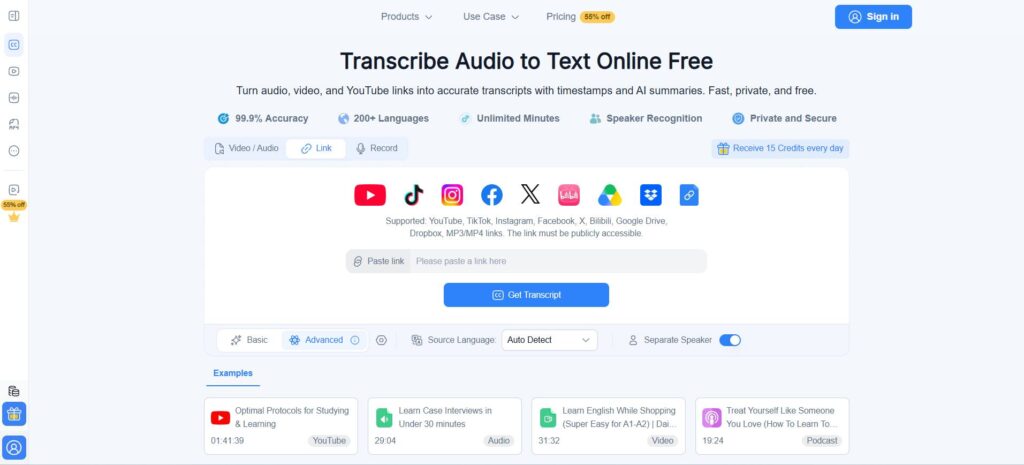
Audio Converter AI provides AI transcription and summarization capabilities for converting recorded content into searchable, editable text.
For Instagram content, its Instagram Transcript Generator offers a dedicated workflow for supported Instagram videos. Facebook video content can similarly be processed through compatible video or audio inputs, with the dedicated Facebook Transcript Generator serving as a platform-specific option. Together they cover most of the Meta videos creators want to study.
The general process is straightforward:
- Open Audio Converter AI and select the appropriate transcription tool.
- Paste a supported video URL or upload your Facebook or Instagram video.
- Generate the transcript using AI speech recognition.
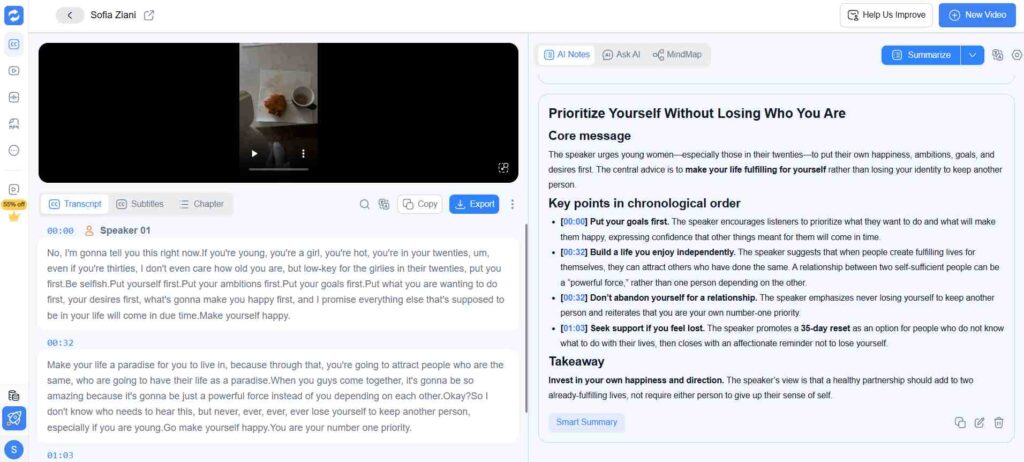
- Review the transcript, including timestamps and speaker labels where available.
- Correct important names, phrases, or terminology before analysis.
- Continue with AI summaries or export the transcript for further research.
The tool supports editable transcripts and several export formats, including TXT, DOCX, SRT, VTT, and CSV.
If you already have an audio-only recording from one of your Meta videos, you can also use the Audio to Text Converter to convert audio to text without processing the full video.
The key outcome is the same: a readable transcript that preserves the spoken message and can support further analysis of Meta videos.
Review and Organize Your Meta Video Transcripts
AI transcription reduces repetitive manual work, but the generated text still benefits from a quick review.
Check creator names, technical terminology, important numbers, and unusual expressions. A small transcription error can change the meaning of a quote or lead to an incorrect interpretation during AI analysis of Meta videos.
For research involving several Meta videos, organize your transcripts with descriptive filenames and basic metadata.
For example, an Instagram Reel discussing productivity habits could be categorized by its topic, content format, opening hook, and creator.
You can also maintain a simple spreadsheet containing source references, transcript files, key ideas, and research notes. Over time, this turns scattered Meta videos into a structured collection that you can revisit and compare whenever you need inspiration.
How to Analyze Meta Videos and Their Scripts with AI
Transcription creates the foundation for content analysis, but the most valuable insights often emerge after the transcript is summarized and examined.
Rather than asking AI to generate a generic summary, creators can use transcript-based analysis to understand how Meta videos present information, which ideas are emphasized, and where new creative opportunities may exist.
Summarize Key Ideas and Content Structure
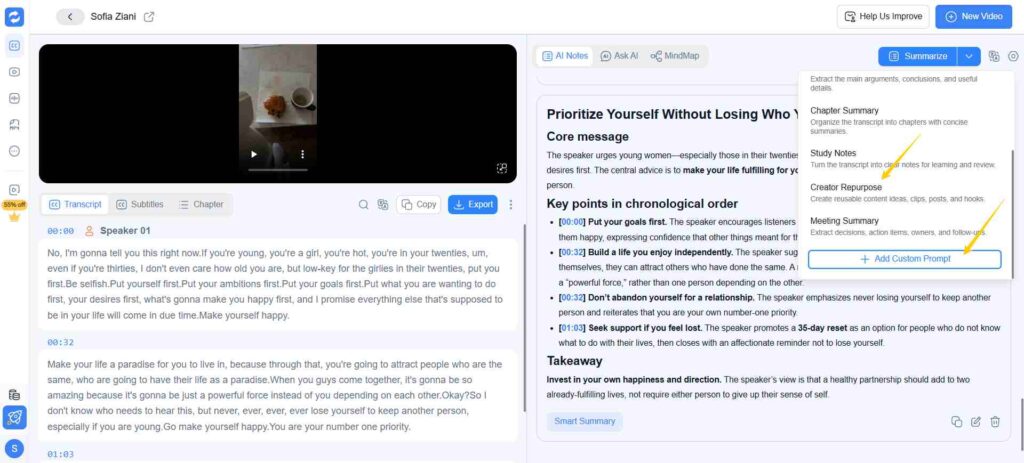
Audio Converter AI offers several AI summarization options, including Smart Summary, Core Points, Chapter Summary, and Creator Repurpose.
These options support different research goals. A general summary helps explain the video's main topic, while a more structured analysis can identify important arguments, examples, and takeaways from Meta videos.
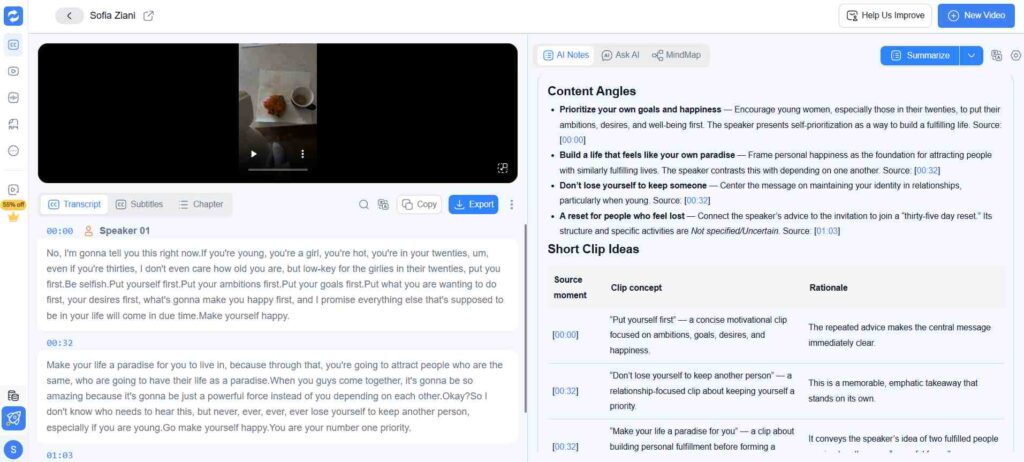
For content creators, Creator Repurpose is particularly useful because it focuses on finding creative opportunities within existing spoken material.
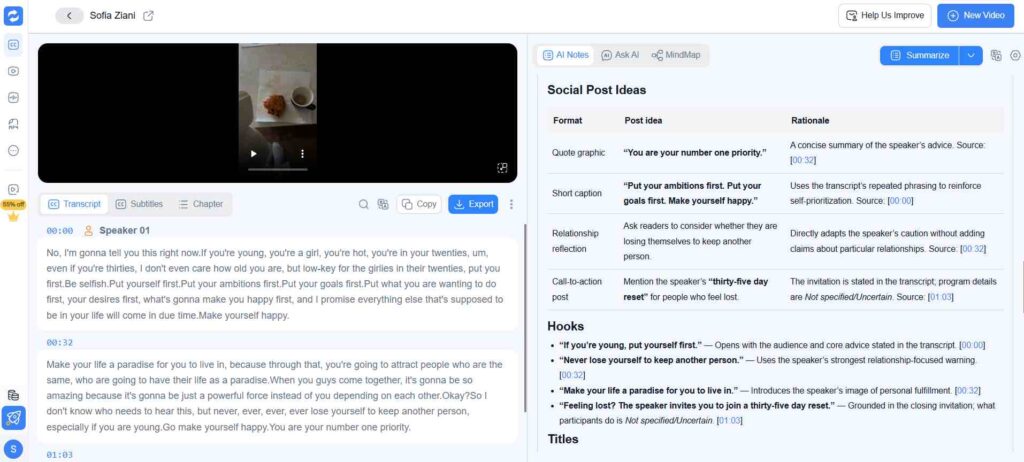
Its output can include:
| Creator Repurpose Output | Research Value |
| Content Angles | Identifies useful themes, perspectives, and hooks |
| Short Clip Ideas | Highlights notable moments with suggested concepts and timestamps |
| Social Post Ideas | Suggests ways to develop selected messages into social content |
For example, imagine transcribing a Facebook video about remote work productivity. Creator Repurpose might identify communication challenges, time-management strategies, and asynchronous collaboration as potential content angles.
Instead of manually reviewing the entire recording, you can examine these suggestions and return to the relevant transcript passages.
Where timestamp references are available, they also help connect AI-generated observations with their original context. This makes research on Meta videos more transparent and useful than relying entirely on an AI-generated summary.
Analyze Hooks, Storytelling, and Creative Patterns
A compelling Meta video often communicates more than information. It presents that information in a way that encourages viewers to continue watching. This matters because Facebook and Instagram feeds are crowded, and the first seconds of a clip decide whether the rest is ever heard.
Transcripts make these communication patterns easier to identify.
Consider four useful dimensions when you study Meta videos:
Opening Hook: How does the creator introduce the topic? A question, surprising observation, relatable frustration, or immediate benefit may establish the video's direction.
Content Structure: Does the video follow a problem-solution framework, tell a personal story, explain a process, or compare different approaches?
Key Message: What central idea should viewers remember after watching?
Audience Engagement: Does the creator encourage reflection, ask a question, offer a practical takeaway, or invite viewers to learn more?
When you transcribe Meta videos, you can identify these patterns directly from the script rather than relying on vague impressions.
For deeper analysis, use a custom AI prompt to classify these elements and request evidence from the transcript.
Compare Content Angles Across Multiple Meta Videos
One transcript can reveal how a creator develops an idea. Several transcripts can reveal how different creators approach the same subject.
Suppose you research five Instagram Reels about learning English.
One creator uses personal storytelling, another presents common mistakes, and a third explains a practical learning method. Their videos address similar audiences but communicate through different structures.
By comparing these Meta videos, AI can help identify recurring topics, distinctive opening hooks, differences in explanations, and content opportunities that receive less attention.
This is especially useful for planning your own content strategy. Rather than imitating the most memorable video, you can understand which approaches already exist and explore a different perspective suited to your audience. Gaps are often easy to spot once ten Meta videos sit side by side as text.
From Meta Videos to Original Script Ideas: A Practical Example
Consider a fictional Instagram Reel about productivity. The following example illustrates how transcript-based creative research on Meta videos can work.
Original Video Transcript
"Ever finish a busy day and wonder what you actually accomplished? Most people start with a long to-do list, but the real problem is deciding what deserves attention. Instead of planning twenty tasks, identify the three that will make the biggest difference today. Focus on those first, and let the smaller tasks follow."
The video is short, but its script contains several recognizable communication elements.
| Element | Transcript Evidence | Analysis |
| Opening Hook | “Ever finish a busy day…” | Introduces a relatable frustration |
| Core Problem | “Deciding what deserves attention” | Reframes productivity around prioritization |
| Main Insight | “Identify the three…” | Offers a simple, actionable method |
| Content Structure | Problem followed by practical advice | Makes the message easy to follow |
After generating the transcript, you can use Creator Repurpose to explore different content angles.
For this hypothetical example, possible angles might include prioritizing important tasks, reducing decision fatigue, or distinguishing meaningful progress from constant activity.
However, these are research observations, not instructions to reproduce the original Reel.
The next step is to connect the underlying insight to your own experience, audience, or expertise.
For example, a creator focused on student productivity might explore the relationship between task prioritization and exam preparation. Someone discussing entrepreneurship could investigate how founders choose between urgent requests and long-term projects.
Both directions develop different subjects from a shared research theme.
To generate more specific original script suggestions, you can use a custom prompt.
Example AI Prompt
Analyze the following Meta video transcript.Identify its opening hook, core message, content structure, and most useful creative techniques.Then suggest three original content angles for my audience.My content niche: [Your topic]Target audience: [Your audience]Main objective: [Educate, entertain, explain, or promote]For each angle, provide an original hook, key talking points, and a short script outline.Use the transcript to understand communication techniques. Do not copy its wording, personal experiences, or distinctive creative expressions.Transcript: [Paste transcript]
The result should be a set of new content suggestions grounded in the creator's actual topic and audience.
This is where AI-assisted research on Meta videos differs from simple content cloning.
The transcript provides source material, Creator Repurpose identifies useful ideas, and custom prompts help develop new creative directions.
The original video remains a reference for understanding how Meta videos communicate, while the final script should contribute something independently useful.
Common Mistakes When Transcribing Meta Videos for Research
Although AI makes it easier to transcribe Meta videos, effective research still requires careful interpretation.
Treating transcripts as complete video analysis. Spoken text reveals language and narrative structure, but visual demonstrations, editing, facial expressions, and on-screen information also matter. Refer to the original recording when necessary.
Assuming popular-looking content guarantees success. Without reliable engagement or performance data, you cannot determine why one of the Meta videos performed well solely from its script.
Relying entirely on AI summaries. AI-generated insights may omit context or misunderstand particular statements. Verify important observations against the transcript and original video.
Copying scripts instead of understanding them. The objective is to identify communication techniques and develop new perspectives, not reproduce another creator's work with minor wording changes.
Good transcript research on Meta videos combines accurate source material, AI-assisted analysis, and independent creative judgment.
FAQs About Meta Video Transcription and Analysis
Can I Transcribe Meta Videos from Facebook and Instagram?
Yes. You can transcribe supported Meta videos from Facebook and Instagram using an AI transcription tool. Depending on the source, you may use a compatible video link or upload a video file to generate an editable transcript.
Can AI Analyze Meta Videos Such as Instagram Reels and Facebook Video Scripts?
Yes. Once you have a transcript, AI can summarize the content of Meta videos, identify opening hooks, examine storytelling structures, and suggest potential creative angles. Audio Converter AI also offers Creator Repurpose and customizable prompts for deeper research.
Can I Generate Original Scripts from Meta Video Transcripts?
Yes. A transcript can provide useful research context for AI-generated script suggestions. For better results, include your own topic, target audience, objectives, and original ideas in the prompt. Review the suggestions to ensure they are accurate, relevant, and distinct from the source Meta videos.
Conclusion: Turn Meta Videos into Creative Insights
Facebook and Instagram offer an enormous variety of videos worth exploring, from educational Reels and personal stories to product demonstrations and brand campaigns.
However, saving interesting Meta videos is only the beginning of meaningful research.
When you transcribe Meta videos, spoken information becomes searchable, editable, and easier to compare. AI summaries help explain key messages, while Creator Repurpose can highlight content angles, interesting moments, and potential ideas for further development.
With Audio Converter AI, you can connect transcription, content analysis, and custom AI prompts into a practical research workflow for Meta videos.
The goal is not to copy successful-looking Meta videos. It is to understand how creators communicate their ideas and use those observations to develop something original for your own audience.
Next time a Facebook video or Instagram Reel catches your attention, go beyond watching it. Transcribe the content, study the script, and discover what new ideas it can inspire.