

Good Tape is an AI transcription platform built with journalists, researchers, and privacy-conscious teams in mind. It supports more than 100 languages, includes speaker labels and AI-generated summaries, and processes data on servers located in the European Union.
That combination makes Good Tape particularly relevant to people transcribing interviews, field recordings, oral histories, focus groups, and sensitive journalistic material.
However, Good Tape is not a complete qualitative research platform. It can produce a searchable transcript, but it does not replace research consent procedures, transcript verification, anonymization, or qualitative coding software.
This Good Tape review examines its suitability for researchers and journalists using current product documentation, pricing information, privacy policies, and published third-party experiences. It does not claim a controlled hands-on accuracy test.
Good Tape Review: Quick Verdict
Good Tape is best suited to researchers and journalists who prioritize European data processing, a mobile recording workflow, and formal privacy documentation.
Its main limitations are the absence of built-in qualitative coding tools and uncertainty around how accurately any AI transcription system will handle overlapping speakers, specialist terminology, strong accents, and poor recordings.
| Category | Assessment |
| Best for | Research interviews, journalism, oral histories and sensitive recordings |
| Languages | More than 100 |
| Privacy | EU processing, GDPR-oriented policies and no training on user data |
| Research features | Speaker labels, summaries, notes, bulk uploads and multiple export formats |
| Mobile recording | Available on iOS and Android |
| Free access | One-hour trial without a payment card |
| Main limitation | Not a qualitative analysis or research data management platform |
| Overall recommendation | Strong candidate when privacy documentation matters more than meeting automation |
Good Tape should be considered when the transcript is the first step in a research workflow. Researchers who need coding, thematic analysis, memoing, or links between transcripts should expect to export the result into software such as NVivo, ATLAS.ti, MAXQDA, or another research environment.
What Good Tape Does—and Does Not Do for Researchers
For researchers, the important question is not simply whether Good Tape converts audio into text. The more useful question is where it fits within the research process.
What Good Tape can do
Good Tape can help researchers:
- Record interviews through its mobile application.
- Upload existing audio and video recordings.
- Separate speakers automatically.
- Generate an initial transcript in more than 100 languages.
- Produce AI summaries for faster orientation.
- Export transcripts in TXT, DOCX, PDF, SRT, or TeX format.
- Organize multiple recordings into Projects.
- Process data within the European Union.
- Provide a Data Processing Agreement for eligible paid accounts.
These features can reduce the administrative work between recording an interview and beginning analysis.
What Good Tape does not replace
Good Tape does not replace:
- Participant consent for cloud transcription.
- Institutional ethics or data protection approval.
- Manual verification of names, quotations and specialist terminology.
- Anonymization or pseudonymization of research participants.
- A formal retention and deletion policy.
- Qualitative coding and thematic analysis.
- Human judgement about context, tone, hesitation or implied meaning.
Automated transcription creates a working document, not an authoritative research record. Any quotation intended for publication should still be checked against the original recording.
This distinction is especially important in health research, legal research, investigations, and projects involving vulnerable participants.
Who Is Good Tape Best For?
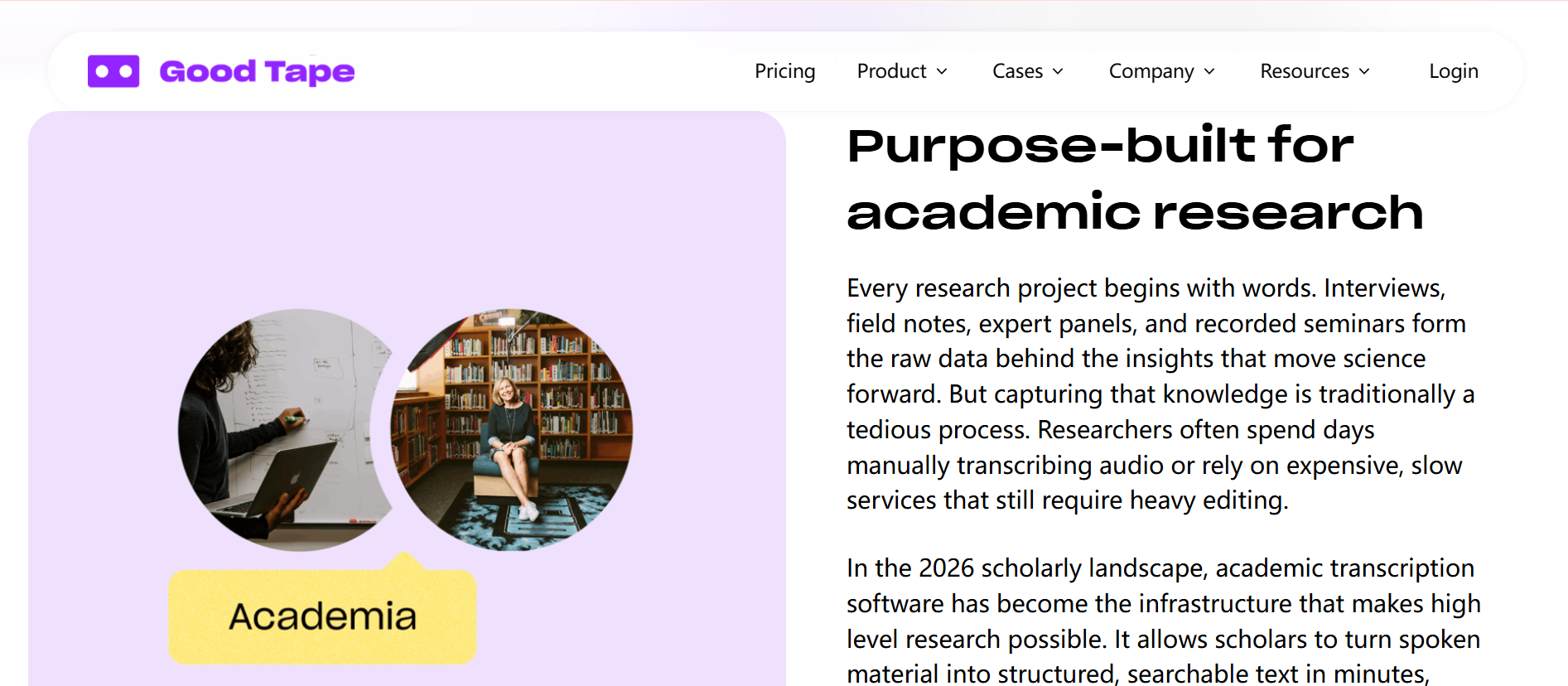
Academic and qualitative researchers
Good Tape is relevant to researchers conducting:
- Semi-structured interviews.
- Doctoral or dissertation interviews.
- Focus groups.
- Oral history projects.
- User research sessions.
- Multilingual fieldwork.
- Recorded research notes.
Speaker labels can reduce the time spent separating an interviewer from a participant. Bulk uploads may also help when a project contains a collection of previously recorded interviews.
The strongest case for Good Tape is a project that needs a transcript before the material is imported into a dedicated qualitative analysis platform.
It is less suitable for researchers expecting the transcription service itself to manage codes, themes, participant attributes, analytic memos, or relationships between sources.
Journalists and documentary teams
Good Tape was developed with journalists as a core audience. Its mobile recorder, EU-based processing and privacy documentation are relevant to reporters working with interviews and recorded source material.
Journalists may find it useful for:
- Recorded interviews.
- Press conferences.
- Field recordings.
- Documentary research.
- Multilingual source material.
- Creating searchable notes from long recordings.
However, a privacy-focused product does not automatically make every upload safe. Recordings involving confidential sources may still require additional precautions, including removing identifying information or avoiding third-party cloud processing entirely.
Teams handling sensitive interviews
Good Tape may also suit nonprofits, policy researchers, consultants and user-research teams that need clearer data-processing documentation than a basic consumer transcription tool provides.
Its Data Processing Agreement is particularly relevant to organizations that must document the relationship between a data controller and a service provider.
A DPA is a legal agreement describing how personal data is processed. It is useful for compliance, but it does not replace an organization’s own legal, ethical or security assessment.
Before Uploading Research Interviews to Good Tape
Researchers should answer the following questions before sending recordings to any cloud transcription provider:
- Does the participant consent form allow third-party transcription? Consent to being recorded does not always include consent to upload the recording to an external service.
- Does the university or organization permit cloud transcription? Some institutions maintain an approved list of software or require a data protection assessment.
- Must the data remain inside a specific region? Good Tape states that its data processing takes place in the European Union, which may help projects with EU data residency requirements.
- Is a Data Processing Agreement required? Good Tape provides a DPA for eligible paid plans, but the research institution may need to review it before use.
- How long can the original recording be retained? The retention period should be defined by the research protocol rather than left to a transcription service’s default setting.
- Can direct identifiers be removed before upload? Researchers can reduce risk by replacing participant names, locations, employers, or case numbers where practical.
- Who will verify and correct the transcript? AI-generated transcripts should be checked before quotations, evidence, or coded passages are used in a publication.
For highly sensitive projects, the decisive question may not be which cloud service has the strongest privacy page. It may be whether the recording should leave an institution-controlled device at all.
Good Tape Features for Research Interviews
Speaker labels
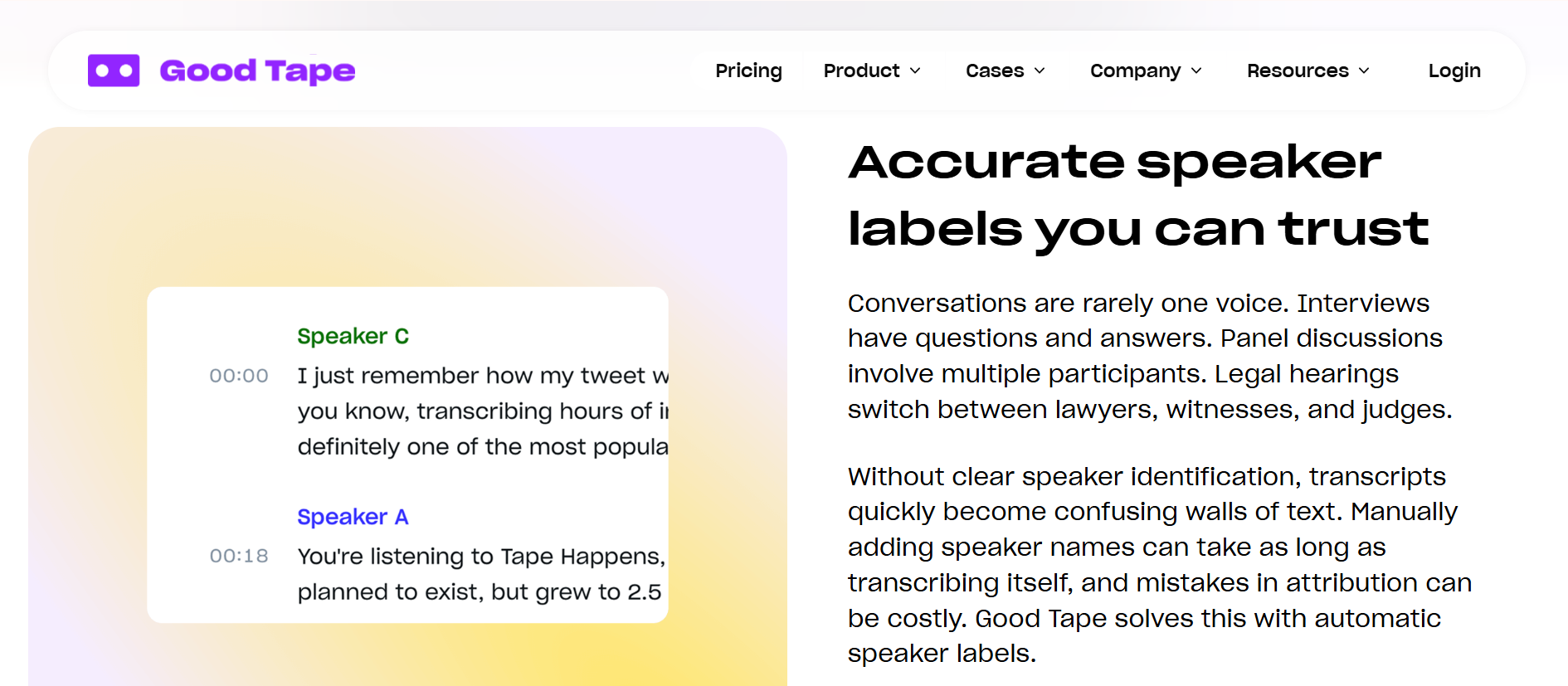
Speaker identification attempts to divide a recording according to who is speaking. This can make interviewer–participant transcripts easier to read.
The feature is useful for two-person interviews, but users should expect more corrections when:
- Several participants have similar voices.
- People interrupt one another.
- Speakers are far from the microphone.
- The recording contains background conversations.
Speaker labels should therefore be treated as an initial structure rather than verified participant identification.
AI summaries and notes
AI summaries can help a researcher understand the general subjects discussed in a long recording before close analysis begins.
They may be useful for navigation, but they should not substitute for thematic analysis. Summaries can compress uncertainty, omit minority viewpoints, or make tentative comments appear more definite than they were.
Researchers should base findings on the verified transcript and recording, not only on an automated summary.
Mobile recording and bulk uploads
Good Tape offers standalone iOS and Android recording applications with features such as real-time monitoring, autosave and desktop synchronization.
This gives it an advantage for researchers collecting new interviews in the field. Bulk uploads are more relevant to projects that already have a backlog of recordings.
The mobile application does not remove the need for a backup recording plan. Field researchers should confirm microphone access, available storage, battery level and upload status before leaving an interview location.
Transcript exports
Good Tape supports DOCX, TXT, PDF, SRT and TeX transcript exports. Audio can also be exported in MP3 or WEBM format.
TXT and DOCX are practical for transcript correction, while SRT is intended for subtitles. TeX support may be useful in academic publishing workflows, although most qualitative analysis programs will still require separately structured imports.
How Accurate Is Good Tape?
No controlled accuracy score is assigned in this review because the service was not tested against a labeled reference transcript.
A third-party review from Media Copilot reported strong results on clear recordings but also encountered repeated phrases and errors in noisier audio. That is a useful observation, but it should not be treated as a universal accuracy rate.
Transcription performance normally depends on:
- Microphone quality.
- Background noise.
- Speaker distance.
- Overlapping speech.
- Accent and dialect.
- Subject-specific vocabulary.
- Language and code-switching.
Researchers should test the service with a representative sample before committing an entire project. A ten-minute excerpt containing typical accents, room noise and technical terms is more informative than testing a studio-quality recording.
For research use, accuracy should be evaluated at three levels: whether the words are correct, whether the right speaker is identified, and whether quotations preserve the intended meaning.
Good Tape Privacy and Security
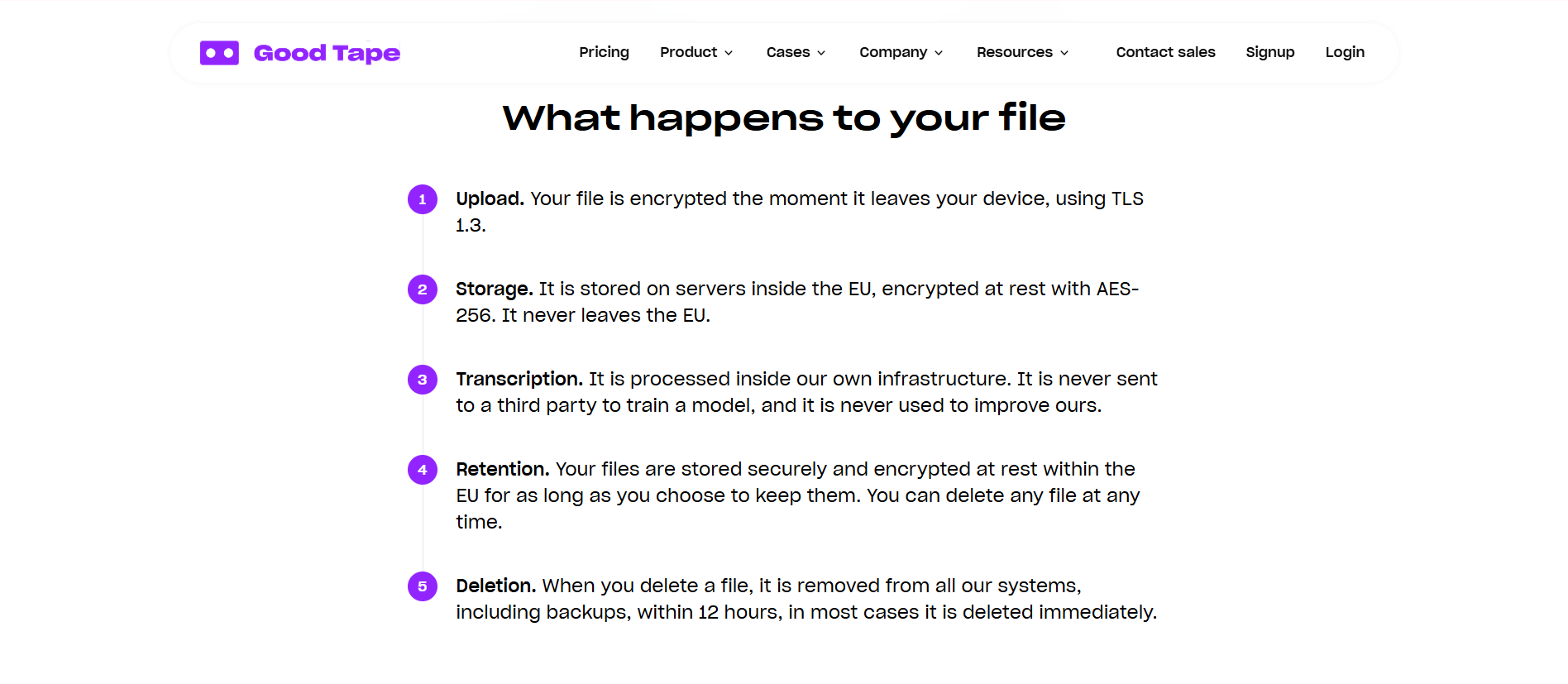
Good Tape places privacy at the center of its positioning. According to its official privacy and security documentation, it provides:
- Data processing on EU-based servers.
- GDPR-oriented data handling.
- TLS 1.3 encryption while data is transferred.
- AES-256 encryption for stored data.
- ISO 27001-aligned security controls.
- A policy against training AI models on customer recordings.
- A Data Processing Agreement for Pro and Business users.
TLS 1.3 protects data while it travels between a user’s device and the service. AES-256 protects stored data if the underlying storage is accessed without authorization.
Good Tape states that recordings are deleted after processing unless the user chooses to store them. Its security documentation also states that user-deleted data is removed within 12 hours and often immediately.
These are meaningful safeguards, but no online service can promise zero risk. Researchers should read the current policies, check institutional requirements and minimize the personal data contained in uploaded files.
Good Tape Pricing
Good Tape’s live pricing page showed the following options when this review was updated:
| Plan | Listed access | Best suited to |
| Free Trial | €0, one hour of transcription, no payment card required | Testing a representative interview sample |
| Pro | Approximately €16 per month when billed annually, with 20 transcription hours per month | Individual researchers and journalists |
| Business | Custom pricing, with 20 hours per seat | Teams requiring administration and contractual support |
The live pricing page and help-center documentation have displayed slightly different prices and free-plan details. Users should therefore confirm the amount and limits shown at checkout before purchasing.
The free trial is enough to evaluate navigation and a sample recording, but it is not enough to judge a large multilingual research project.
Good Tape Pros and Cons
Pros
- Designed around journalists and interview-based work.
- Processes data within the European Union.
- Supports more than 100 languages.
- Includes speaker labels and AI summaries.
- Provides mobile recording applications.
- Offers multiple document and subtitle exports.
- Makes a DPA available for qualifying paid accounts.
- States that customer recordings are not used for model training.
Cons
- Does not provide qualitative coding or thematic analysis tools.
- AI summaries still require comparison with the full transcript.
- Speaker labels may need correction in group discussions.
- Pricing information has not always been consistent across Good Tape pages.
- The 20-hour Pro allowance may be restrictive for large interview archives.
- Privacy policies do not replace research ethics approval or participant consent.
Good Tape vs Audio Converter AI
Good Tape and Audio Converter AI overlap in transcription, but their strongest use cases are different.
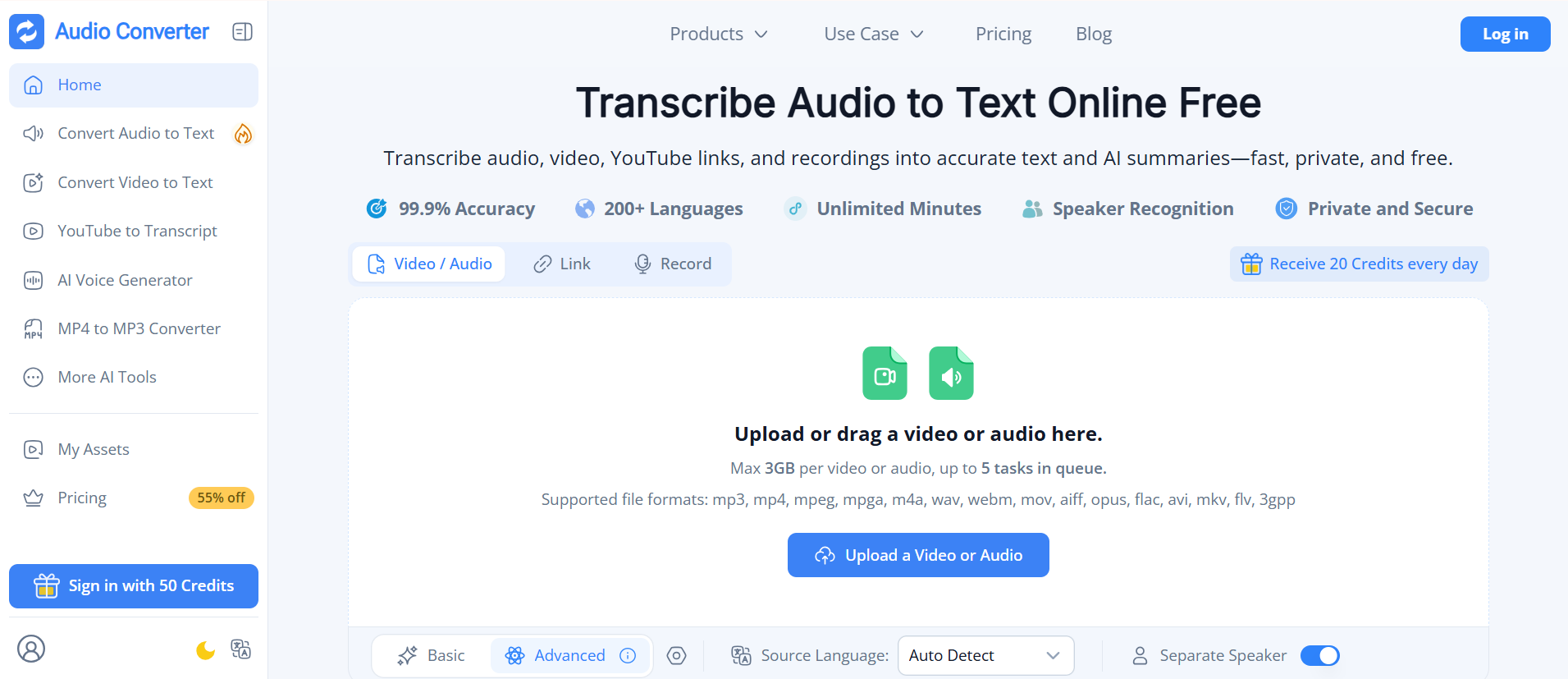
| Feature | Good Tape | Audio Converter AI |
| Main positioning | Private transcription for journalists and interview-based work | Browser-based audio, video and YouTube transcription |
| Languages | More than 100 | More than 200 claimed |
| Free access | One-hour trial | Daily free transcription allowance |
| Mobile recorder | Dedicated iOS and Android app | Primarily a browser workflow |
| Input types | Uploaded and recorded media | Audio, video, recordings and YouTube links |
| Research privacy strength | EU processing and DPA availability | Private processing and automatic file cleanup |
| Additional tools | Projects, summaries and transcript exports | Audio conversion, transcription, summaries and AI voice tools |
| Best fit | Sensitive interviews and formal research workflows | Fast browser transcription and mixed media formats |
Choose Good Tape if:
- EU-based processing is an institutional requirement.
- A Data Processing Agreement is needed.
- Interviews will be recorded through a mobile application.
- The project contains sensitive journalistic or research material.
- Bulk interview organization matters more than media conversion.
Choose AudioConverter.ai if:
- You want to transcribe without installing a dedicated application.
- Your source material includes audio, video and YouTube links.
- You need a recurring free allowance instead of a one-time trial.
- You also need to convert audio formats.
- The work is a general transcription task rather than a regulated research workflow.
Audio Converter AI offers a free plan with daily usage. Paid plans increase transcription allowances and supported file sizes. Users should check the current Audio Converter AI pricing page before selecting a plan.
Neither service should be selected solely from a feature count. The better option depends on data sensitivity, source format, institutional policy and expected transcription volume.
Final Verdict
Good Tape is a credible transcription option for researchers and journalists who need EU-based processing, speaker labels, a mobile recorder and formal privacy documentation.
Its strongest use case is converting recorded interviews into working transcripts that will later be verified, anonymized and analyzed elsewhere.
It is not a substitute for participant consent, research data management or qualitative analysis software. Researchers expecting automatic transcription to produce publication-ready quotations or finished themes will still need a separate verification and analysis process.
For sensitive research interviews, Good Tape deserves consideration because of its EU infrastructure and DPA availability. For everyday browser transcription involving audio, video or YouTube sources, AudioConverter.ai offers a broader input workflow and recurring free usage.
The final decision should be based on a representative sample recording and the data-handling requirements of the project, not on a headline accuracy claim.
Frequently Asked Questions
Is Good Tape free?
Good Tape offers a free trial that includes one hour of transcription and does not require a payment card. Current limits should be verified on its pricing page.
Is Good Tape suitable for academic research?
It can be suitable for producing initial transcripts of interviews, focus groups and field recordings. It does not replace ethics approval, anonymization, transcript verification or qualitative coding software.
Is Good Tape safe for confidential interviews?
Good Tape provides EU processing, encryption and GDPR-oriented documentation. Whether it is appropriate for a confidential interview depends on participant consent, institutional policy and the sensitivity of the recording.
Does Good Tape use recordings to train AI models?
Good Tape states that it does not use customer recordings to train its models. Researchers should confirm the current policy and any contractual requirements before uploading sensitive data.
Can Good Tape identify different speakers?
Good Tape includes automated speaker labels. Their accuracy may decline when people interrupt one another, have similar voices or are recorded in noisy conditions.
What is the best Good Tape alternative?
For browser-based transcription of audio, video and YouTube links, AudioConverter.ai is a practical alternative. Meeting-focused users may prefer a meeting assistant, while researchers needing formal coding should use dedicated qualitative analysis software after transcription.